

This is the conclusion of my series on William Blake’s “Proverbs of Hell” from his book The Marriage of Heaven and Hell. This is the first post in the series, and I will have a list of the entries at the end.

I’ve been struggling with this conclusion, partly because the Proverbs themselves are only part of a larger work of rhetoric and art that do not stand as well by themselves as they do within a larger context. Also, because of their situation on the chaotic side of Blake’s personal ideology, I think they avoid lending themselves to a broad overarching interpretation. That sense of cohesiveness is not the goal of the work, just as narrative is not the goal of poetry.

There are some consistent themes: the advice for allowing and warning about excess, the condemnation of repression, the recommendations for prudence and perception around others while maintaining a sense of generosity and congenial tolerance, the wry sense of humor around human foibles. There are consistent devices: the extensive animal metaphors, the subtly parodic village characters that pop in and out of the metaphors, the juxtaposition of those folksy observations with the terror of nature and responsibility.

There are consistent stylistic choices that display a deep playfulness and joy behind the work. The vivid colors, the haphazard text colors, and the intentionally precise handwriting still showing the person behind the brush. For almost a century we have mostly generated text by machine and are accustomed to seeing regular lines that can be produced hundreds of times per minute, and here we are confronted by a pen that frequently runs out of space before it runs out of words and has to cramp the letters to get them to fit. Sometimes a line languishes in a vast expanse of watercolor tones because the next line was too long. Little doodles and irregular letter flourishes make sure that every little piece of space on the paper has something to look at, while the text still stands out enough to remain readable and distinct. Which is not as easy to do as it may seem, especially since most of the versions we have have almost certainly faded and oxidized over time.

Of course the illustrations deserve a mention, but they point to other parts of the larger work to contextualize the proverbs themselves. They are moodily colored, but they don’t betray the environment of dreamy divinity that envelops most of the pages. The heavenly scribes and the demons are all working together to compose the literature of this strange place and that process is as foible filled and entertaining to observe as a human construction site.
These proverbs propose an easy, experienced wisdom that is laid back but still chooses action over reaction every time. This stands in sharp contrast to more conservative or regressive styles of wisdom that, in comparison mind you, advocate a prudish miser’s approach to life. I think this exact contrast is the purpose of the work, to shadow the edges of the bleak moralism presented by Anglicanism of the day and draw out the beautiful details in the nuances of that faith. The blank faced optimism of mindless obedience is not an acceptable substitute for the hard won experience that creates and informs true wisdom and kindness.
Since I don’t want to treat the rest of the book with the same microscope I’ve used for the Proverbs, here are some of my favorite passages from the rest of the work:
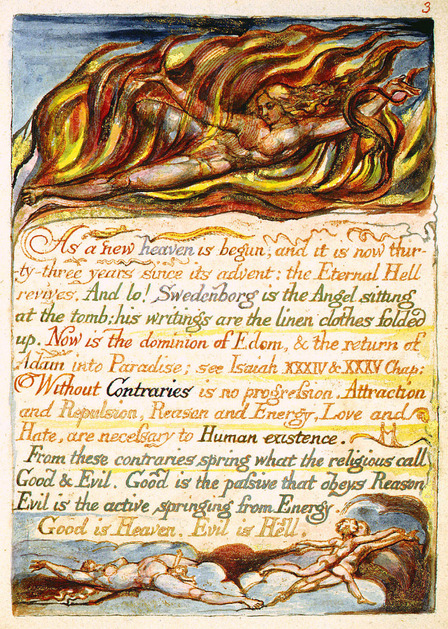
“Without Contraries is no progression. Attraction and Repulsion, Reason and Energy, Love and Hate, are necessary to Human existence.
From these contraries spring what the religious call Good & Evil. Good is the passive that obeys Reason. Evil is the active springing from Energy.
Good is Heaven. Evil is Hell”
That’s from the few pages that introduce the Proverbs, they make it clear that what Blake is trying to do is address the bad reputation that Swedenborg and Milton had given Hell as a part of the creation of the same loving God that they ascribed Heaven to. This theme of duality is what the entire structure is hinged on and also leads to one of my favorite disses of all time.
In a portion labeled “A Memorable Fancy” Blake is approached by an Angel who reminds him of the “hot dungeon” prepared for him in hell, so he asks to see the place prepared for him. The pages are densely packed exposition text so I won’t post them here, but the Angel leads Blake through an elaborate series of places to the basement of an old mill, and underneath the mill they descend into the pit. The Angel describes dark and complex scenes of scary underground creatures and devices of suffering. There are smoke choked cities, molten lakes, enormous spiders, and Leviathan itself is looming over the proceedings with eyes as big as the sun and moon. It lunges at Blake and the Angel. The Angel flees back up to the mill in terror while Blake stands his ground. The solar system scaled beast vanishes and is replaced by a peaceful scene by a river. Blake goes back up to find the Angel still in the mill and offers to show the Angel his respective fate. I won’t try to summarize the grisly scene, but it is dense with metaphor and describes seven houses of brick underneath a Church altar. Filled with scenes of primal violence and stark repression. Blake is clear that he is being graphic and torturous on purpose when the portion concludes with these lines:

“So the Angel said: thy phantasy has imposed upon me & thou outest to be ashamed.
I answered: we impose on one another & it is but lost time to converse with you whose works are only Analytics.”
Which then on the next page is followed up with

I have always found that Angels have the vanity to speak of themselves as the only wise. this they do with a confident insolence sprouting from systematic reasoning
That this made me go “WHOAAA” probably says more about me than the target of Blake’s joke. The next line has “Thus Swedenborg” in the same ink color as the Angel and I don’t think you can make it more obvious that this elaborate fantasy has been Blake’s shower argument with Swedenborg. A huge “Nuh uh!” to the prominent theology of his day. “We impose it upon each other” is pointing out that at the end of the day, Swedenborg has no better claim to authority than any crackpot with a quill and ink pot. Swedenborg is clothed in Angelic glory because he claims the systemic, the objective, the “divine” rational that pounds out truth in block letters. He is relying on the routine operations of such systems to lend him their own authority and might without embodying virtues outside of the system. Though he and all his followers will repeat that his claims are the harsh truths of a bleak world that is self evident (according to the system in which they live,) he’s still ultimately speaking on matters that are hidden from the direct experience of any human being. He has no better idea of heaven and hell than a dog, but presumes to speak like he was disappointed with the hotel prices last year.

Thus one portion of being is the Prolific, the other, the Devouring: to the devourer it seems as if the producers was in his chains, but it is not so, he only takes portions of existence and fancies that whole. But the Prolific would cease to be Prolific unless the Devourer as a sea received the excess of his delights.
There’s a lot to say about this page, but I have to draw the line somewhere so I’m selecting out this one part.
This illustrates an important distinction in mindsets that is not often expressed. There are many in the world who seem to exist to be Devourers, and despite the name sounding like something you need to spray for every six months, they have to exist or else the Prolific wouldn’t have the space to proliferate. The two must exist in balance and ascribing one or the other side a correctness or a justifiable inequity is pointless because their very nature demands each other in definition.
Of course these are massive generalizations, and I think drawing easy comparisons like artists vs consumers isn’t the point of this, but to demonstrate that it’s the balance itself that’s more important than the individual wins and gains on each side. There is also a lurking political angle that I will only say I do not think works either way and leave it at that.
Even Blake has the disclaimer that “Some will say” to remind people that conflating some larger purpose in the Prolific is still drawing conclusions about the universe from the interior, goo-in-a-skull, thoughts of human beings. To finish off the point he says these two varieties of people will always be at cross purposes on Earth, but that trying to stop them is like trying to destroy the world itself. Which he ran out of room for and it’s crammed at the top of the next page. In this case, the Devouring backspace key would have helped the Prolific writer.

One Law for the Lion & Ox is Oppression
I appreciate the illustration of Nebuchadnezzar here as a metaphor for one who is humbled and gains wisdom before returning to sanity and agency. The little bit above about the Angel becoming a Devil and they have Bible studies together is charming and I have an affinity for the line: “I have also: The Bible of Hell: which the world shall have whether they will or no.” It’s an attitude I have to take whenever I hit publish on anything online. Woe, for my works be upon you.
But my favorite thing on this page is the line I quote in bold above, because I think it’s the best summation of the Proverbs and the book itself: that the rigid philosophy of one law shackles nature. That there is no system of rules and regulations that will work to benefit both Lion and Ox simultaneously without oppression. Blake has demonstrated over and over again his opinion of oppressors and their ilk, and that he believes they represent a destructive impulse that would shackle and destroy the very cycle of life and death itself.
I’ve read some analysis that places Blake among ideas like Hegel’s Dialectics and Jung’s work. While that approach makes sense to me, as an appreciator of Blake as a relic of his time, I don’t find much value in reading him in their context. There isn’t much new about the idea of life and death being cycles that revolve around each other being also representative of how suffering and joy works in a human’s life story. This just represents a particular vision of it, and a particularly remarkable conception of that balance being contained within human perceptions for that time.
I’m going to cut this short because I do still recommend reading the entire thing. There is a section where Blake sits down with Isaiah and Elijah that I’ve mentioned before that really shows where Blake was at on the whole concept of religion, but then veers into some ideas that are in very antisemitic waters, use your adult discretion. There’s a section about the origin of priesthood that depicts it to be a blatant interjection between the natural connection between God and man which he maintains is a wholly interior experience. The book finishes with what I can most accurately describe as a manic song, dense with metaphor and poetic devices that require someone with much more knowledge than I have to parse on any level other than raw appreciation. The entire work finishes with this chorus:

Let the Priests of the Raven of dawn, no longer in deadly black, with hoarse note curse the sons of joy. Nor his accepted brethren, whom tyrant, he calls free: lay the hound or build the roof. Nor pale religious letchery call that virginity that wishes but acts not!
For every thing that lives is Holy
Thank you for reading this series on “The Marriage of Heaven and Hell” and the Proverbs of Hell. I’m considering recording this as a series of videos since that’s how people get the word out about things these days, but I’m also likely to just let this sit as a series of blog posts. If you’ve found entertainment or joy or rage or even mild irritation from this series, please comment or tell a friend about this weird tiny blog you’ve been reading. It’s so retro.
I’ll be back with some other old piece of culture no one’s thought about in a while.
Introduction to this series
Proverbs of Hell 1
Proverbs of Hell 2
Proverbs of Hell 3
Proverbs of Hell 4 and 5
Proverbs of Hell 6
Proverbs of Hell 7 and 8
Proverbs of Hell 9
Proverbs of Hell 10
Proverbs of Hell 11
Proverbs of Hell 12
Proverbs of Hell 13
Proverbs of Hell 14
Proverbs of Hell 15
Proverbs of Hell 16
Proverbs of Hell 17
Proverbs of Hell 18
Proverbs of Hell 19
Proverbs of Hell 20
Proverbs of Hell 21
Proverbs of Hell 22
Proverbs of Hell 23

 Wheeler's Place