

I wasn’t going to work on these on the weekend but missing those days earlier has me feeling restless so this is the 15th entry in my series on William Blake’s “Proverbs of Hell” see this post for context.

The tygers of wrath are wiser than the horses of instruction.
I love the little swoosh keeping the rest of instruction contained from the lower line, like we would be in danger of speculating about water.-struction. (we would, I would)
I only point that out because the rest of this line is so puzzling. It’s another direct comparison, only this time with a weighted result. The “Tygers” (which is a better spelling) of wrath, are held up as wiser than the horses of instruction. Wiser does not necessarily mean better, only embodying every virtue better and conveying them more intelligently, but we can make some inferences.
Horses in animal symbology are complicated. I broke out some books on symbology and did some googling. I also took a peek at some tiger symbols while I was out there. From reading a bunch of encyclopedia level entries on both animals, I’m struck by how entangled in royalty both animals are. They are both “agency” animals, the horse representing nobility and freedom with an undercurrent of industry, while the tiger represents fierce, kingly action with a surprisingly deep water element. The modifiers that Blake applies are wrath and instruction. Wrath is self explanatory, defensive violence are already default mode for tigers.
Horses of instruction however, imparts an almost institutional tone to the combination that I find interesting. The first impulse was to view it as plodding, routine education, but I think with horses having the element of nobility and transportation and military power, it is also a warning against a stagnant institution. Against an enshrined system of rigid, delineated structure, a liquid, wrathful tiger is judged more wise. This feels in character for Blake while also having a lot of intuitive appeal. A wry statement that in a world such as this one, the old regal monarchy of swift brutal conflict is more wise than instruction by traditional, democratic horses.
Expect poison from the standing water.
I’ll be honest, having this entry tucked under the previous has influenced my perspective on both, and I don’t think you can claim that’s by accident. It’s a type of literary rhetoric that is completely missing in a world where everything is produced on and readable by computers. Copy and pasting the two statements robs them of the implications that having this one in a smaller font, crammed between the previous and next entries could convey. I think you could argue that this may have just been a mistake that Blake would have corrected if it was worth doing an entire new plate for, but we’re both talking out of our asses if we’re trying to read Blake’s mind. What we have is what is preserved.
To get to the point, I wouldn’t normally take survival tips from two centuries ago, but this one is good. Humans have a mistrust of standing water so deep that even people who have lived their entire lives inside urban environments will often feel uneasy about stagnant water. Ironically because stagnant water is a great environment for all manner of biology, just not most mammalian digestive systems. Like how one of the worst smells is a rotting corpse, still puddles of fluid are so dangerous to consume that we are naturally averse to it, even while it enriches the rest of the environment with decay.
Everything that enters standing water influences it, toxic, poisonous, or nutritious. Even soup has to boil to eliminate poison, and that’s the closest to consuming a fetid pond that we get. The movement is one of the important parts. The very things that make water a dangerous environment to live in: movement, extreme temperature, larger predators that can withstand such environments. All of these make something less poisonous, more safe for consumption by lifeforms like us. To fully link this to the above, the furious revenge and whims of the tiger king are more linked to human welfare and agency while the staid and constant horses of instructive authority brew poison in their prosperous waters.
I’m not sure how far I agree with Blake on this point, it’s instructive to remember that he lived in the seat of the British Empire at its height, so with King Charles III living down the road I can see why he may have a preference for monarchic state action.
You never know what is enough unless you know what is more than enough.
This takes me back to a couple weeks and two pages ago when Blake repeated this point several times. It also reminds me of this Calvin and Hobbes comic:
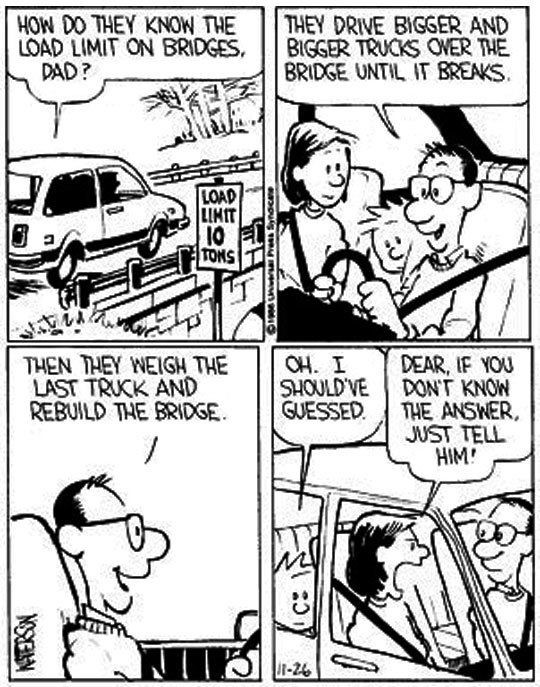
There is a lot of sense in the idea that you can’t really know for sure where a limit is until it’s broken. At the same time there’s a version of this comic that is much less funny and I don’t feel like devoting the server space to it. In that one, Calvin’s Dad has had his dialogue replaced with architectural load diagrams and some matrices and Mom’s line is removed.
I don’t think Blake would have liked the idea of directly substituting mathematical calculations and predictions for the hard data of experience. It runs contrary to the rest of the work’s views. So why mention two different versions of an unconnected text?
Because that temptation is seductive, Blake is recommending against the behavior of “taking someone else’s word for it.” Speaking as someone who has done this many times, accepting someone else’s limits as your own as a substitute for direct experimentation doesn’t satisfy the curiosity or give the benefits of knowing your own limits. Without that direct experience, it’s a different kind of knowledge without the benefits of linking deep with your own memories and emotions. You become like the workmen who built the bridge, accepting a blueprint from a designer without their own input or understanding, and erected a sign with no hard knowledge of whether that sign was the result of experience or just a mathematician’s best guess.
People who do math for a living do not like hearing this, but all the math in the world is not equal to a single hard result. That’s why the Large Hadron Collider exists, because we had almost all the math in the world proving the existence of these particles, but it was still worth spending billions and reshaping landscapes to prove that our calculations were reliable. Science is the formalized process of questioning the weak spots in logic and hypotheses, and spots without physical evidence are always the weakest.
People who do rhetoric for a living do not like hearing this, but all the axioms, phrases, jokes, and commandments in the world will not equal one single hard consequence. Not one piece of patriotic or religious motivation equals a real life biological need. There is no secret text that when you read it, you have finished “wisdom” or “experience.” I don’t want to post the speech from Good Will Hunting about smelling the ceiling of the Sistine Chapel, but I will recommend that everyone go outside and get a couple big lungfuls of tree breath
Music:

 Wheeler's Place
1 Comment