
William Blake was a poet, painter, and printmaker who lived in London from 1757-1827. He died unknown, but was revived when his biography was published 40 years later. The quality of his character and sincere devotion to Christianity sets him apart from many of his peers. Unfortunately much of what we know about him is limited by his early obscurity and having most of his work reportedly discarded by a deeply conservative church in charge of his records before it could be published, but we can piece a lot together along with correspondence and other’s records.
He showed a deep belief in the moral basics, a commitment to lifting others up with his own efforts, and boasted an education and understanding of theology that led him to interesting places. He’s one of those artists who was so far ahead of his own time that he’s now most famous as the prototypical version of things that have claimed him in their historical lineage. His partnership with his wife Catherine Boucher (who was illiterate when they met, we know because the English still have the wedding license she signed with an X preserved in that church) was noted as atypical for his time and place because she worked both as an engraver and colorist for his printmaking business, and, after he died, she carried on distributing and organizing his work until she herself passed. He was an early abolitionist, a supporter of the American and French revolutions, hated the Anglican church, and worshiped at the feet of John Milton. Overall his opinions demonstrated a rare level of disillusion with and understanding of authority in more than just civic life, which would precede many other theorist’s much more radical understandings.
From what we can tell, as he aged, he distanced himself from a lot of those ideas and embraced the deeply religious and personal aspects of philosophy, engaging more with the metaphysical and poetic than the worldly or practical. Seriously, just a rad dude as far as classic writers of that time go. Also he was friends with the best founding father Thomas Paine, so there’s that too.
You can find all this on the Wikipedia if you’d like, there and the decade old memories of one class period in a survey course is where most of this info comes from.
Unfortunately for Blake, one of his most famous books has a title that has been pissing people off who haven’t read it for centuries now. It’s called The Marriage of Heaven and Hell.

Whatever your opinion of its contents, the book itself is gorgeous. A meditation on what the actual implications of this religion based on the traditions of Judaism meant, filtered heavily through Milton’s Paradise Lost. Seriously, this guy loved Milton.
As a personal note, I generally do not care for most of Milton’s work, I find it tedious and the people who work on it more so. However, it’s almost another book of the Bible it’s so fundamental to modern beliefs about the dynamic of Heaven vs. Hell in modern American Christianity. Half of the shit we “know” about Angelic mythology and Demons and the Fall is filtered through Milton’s interpretation. Blake wanted to continue that tradition by engaging with Christian thought in a way that wasn’t typically appreciated. It’s laid out as a rebuke of legalism and shame in Christian tradition, a tender appeal to the heart for humanity as a feeling, understanding creature in a world bursting with opportunities for feeling and understanding. It’s the freshest tropical fruit you ever bit into, but laid out in a densely handwritten script packed with illustrations.
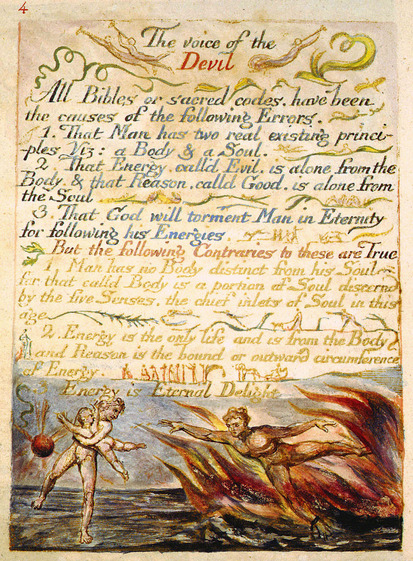
Depicted on this page you have The Voice of the Devil who is here presented not as a mean-spirited goat demon in red pajamas, but the earnestly questioning errant son that drove the plot of Paradise Lost, the musing Satan of Job, the tempter in the desert. The one sent to guide man through struggles with topics that the books didn’t care to touch. Why do bad things happen to good people and the reverse? Why does fortune favor the craven more often than the meek? What is the point of indulgence? Why turn down kingdoms and riches and feasts for death? Why persevere in your faith when every physical sense is telling you otherwise? Those are the questions that the Enemy represents in Blake’s mind. His hell is a distinct place with fantastic visions of caves filled with dragons. With their fire they melt the petrified mountain of the Pit into piles of assorted metals to be cast into the void by giants, to seed new life back into the universe.
You may be detecting an ounce of poetic liberty being taken here. There is little to no Biblical basis for this, and most of it is entirely made up by Blake, who was also intentionally satirizing Emanuel Swedenborg’s “Heaven and Hell” (even less well known, take a class about it.) In the grand tradition of Dante and Milton themselves, a lot of his personal mythology springs from his own life experiences and personal vendettas, but should also be taken as inspired by those and not spiritual reflection or inspiration. There is no perfect prophet, and one of the sections of this book has the narrator sitting down with Isaiah and Ezekiel, you know, from the Bible, and talking to them about their work. They tell him “do what you gotta do to get the word out, man, but don’t get too wrapped up in it, brother” before skipping town, which seems accurate to their scriptural personalities.
My point is, this is not scripture, this isn’t even Gnostic. Despite claims of heresy, what’s in The Marriage of Heaven and Hell is one man’s attempt to thread the needle and really say something about this whole business. To stand up in front and try to get some passion going, this is life and death we’re talking about. A man to speak up for the little guy and tell the priest to get the boot off his neck.
Over a century later, C.S. Lewis wanted a snappy title for his own contribution to the genre when he wrote The Great Divorce in supposed response (talk about resurrecting an old forum post.) It has been more than a decade since I read it, but the works have entirely different motivations and goals. Lewis was engaging with a different form of faith than Blake, both for his own beliefs and the doctrine he was interpreting. I enjoyed it when I read it, but I’ve found little similarity between the two and don’t want to read a whole extra book just for this paragraph.
The most fun part of William Blake’s troublesome little poem/pamphlet/whatever is this section:
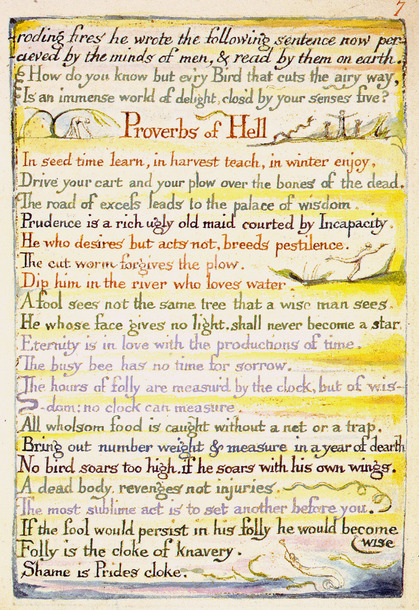
I love lists, and if I know the Internet, it loves lists too. This is the first page of The Proverbs of Hell, which seems to be errata for Blake. A slightly vinegary take on the pragmatic and bleak advice of the older part of scripture. A patch notes to the part of the Bible responsible for half of Hobby Lobby’s stock. There are some themes here and there but mostly the advice feels random and wry, with the same wink a bitter relative or a drunk bartender might throw when they think maybe you’d appreciate it.
I’m gonna be writing about these a few at a time on here, I just think it might be fun. Maybe I’ll get a cartoon out of it or two who knows.
Music for today:
Modern Pop (maybe K-pop? I dunno)
Neo Traditional Country

 Wheeler's Place
21 Comments